

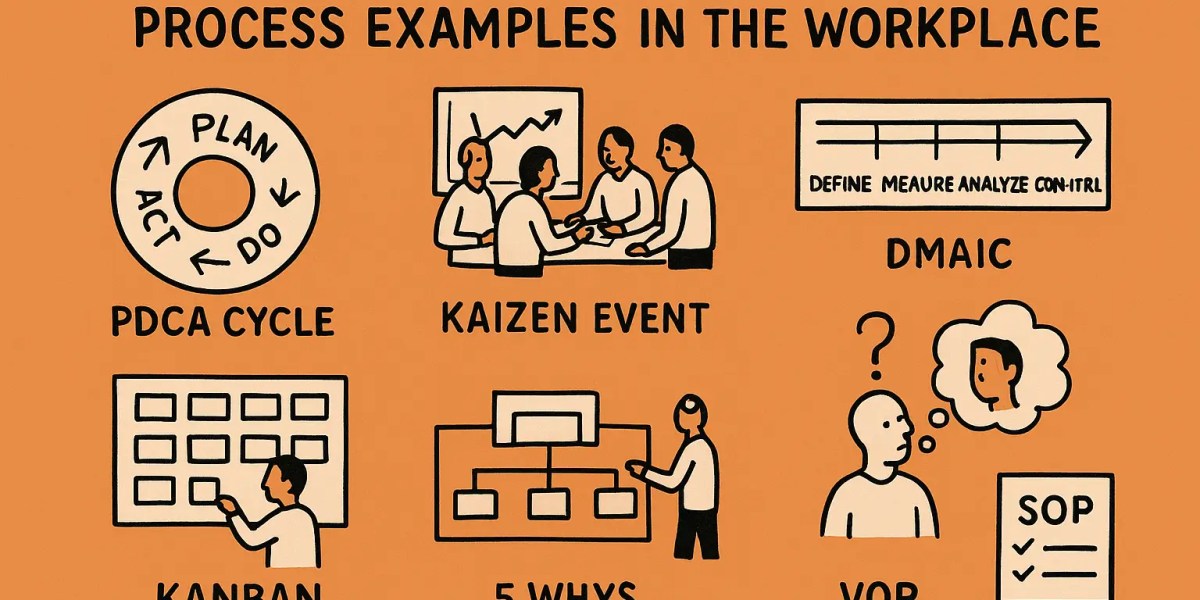
You know continuous improvement matters, but a slide deck full of theory doesn’t tell you what continuous improvement looks like on your shop floor or in your billing department on a Tuesday afternoon. That gap between concept and application is exactly where most improvement initiatives stall. If you’re searching for continuous improvement process examples you can actually picture in your own operation, you’re in the right place.
This article gives you an example of continuous improvement process work drawn from real workplace situations, not abstract frameworks. You’ll see how teams use tools like kaizen events, PDCA cycles, and 5S audits to solve specific problems, cut waste, and build habits that stick long after the initial push fades.
We cover eight scenarios spanning different industries, including several continuous improvement examples in manufacturing alongside cases from service and administrative settings. At Lean Six Sigma Experts, we’ve implemented these exact methods on client floors for over a decade, so each example reflects what actually works, not just what looks good on paper. By the end, you’ll have concrete ideas ready to adapt for your own team.
1. Plan-Do-Check-Act cycle
The Plan-Do-Check-Act cycle, often called PDCA or the Deming Wheel, is the backbone of most continuous improvement process examples you’ll encounter in the workplace. It breaks continuous process improvement into four repeatable steps rather than a one-time fix, which is why it holds up across industries as different as food processing and insurance claims handling.
How it works
Teams start by planning a change based on a specific problem, then run a small-scale test of that change before rolling it out. During the check phase, you compare actual results against your prediction using real data, not gut feel. If the numbers hold up, you standardize the change; if they don’t, you adjust and cycle through again. This loop structure is what separates PDCA from a typical example of continuous improvement process that stops after one fix.
A change that isn’t tested on a small scale first is just a guess with extra steps.
Best use cases
PDCA suits situations where you’re not fully certain a solution will work and want to limit risk before committing resources. It’s a natural fit for:
- Testing a new inspection checkpoint on one production line before plant-wide rollout
- Piloting a revised customer intake form in one branch office
- Adjusting machine settings incrementally to reduce scrap rate
- Trialing a new shift handoff procedure with a single team
Example in practice
A mid-size auto parts supplier we worked with had recurring dimensional defects on a stamping line. The quality team planned a change to die maintenance intervals, shortening them from 30 days to 21. They ran the new schedule for two weeks on one press, checked scrap data against the baseline, and found defects dropped by 40%. Because the check phase used hard numbers instead of assumptions, leadership approved standardizing the shorter interval across all six presses within a month. That’s the kind of disciplined, low-risk testing our Lean Six Sigma consulting teams build into client engagements from day one, so improvements survive past the pilot stage.
2. Kaizen events for rapid improvement
Kaizen events pull a cross-functional team off the floor for three to five focused days to solve one specific problem, rather than waiting months for a committee to circle back with recommendations. This concentrated format is one of the fastest continuous improvement process examples to show a measurable win, which makes it a favorite for teams that need momentum, not just a plan.

How it works
A kaizen event starts with a clear problem statement and a chartered scope, so the team doesn’t drift into unrelated issues. Day one usually covers current-state mapping and data gathering, the middle days focus on testing changes directly on the floor, and the final day locks in new standard work with visible metrics posted nearby.
Rapid improvement works because the team fixes the problem where it lives, not in a conference room three floors away.
Best use cases
When to use a kaizen event: they fit best when a problem is well-defined, contained to one area, and needs a fast turnaround:
- Reducing changeover time on a bottleneck machine
- Reorganizing a cluttered tool crib or supply closet
- Cutting steps in a repetitive paperwork process
- Improving flow at a single workstation causing downstream delays
Example in practice
A packaging plant client ran a five-day kaizen event targeting changeover time on its main filling line, which was eating nearly two hours per switch. The team mapped every step, spotted seven that could happen while the machine still ran, and rebuilt the sequence. By day five, changeover time dropped to 45 minutes, a result the team locked into a new standard operating procedure before leaving the floor.
3. Six Sigma DMAIC methodology
DMAIC stands for Define, Measure, Analyze, Improve, Control, and it’s the structured backbone behind most Six Sigma DMAIC methodology projects tackling chronic, data-heavy problems. Unlike a quick kaizen event, DMAIC suits issues where the root cause isn’t obvious and you need statistical rigor to prove what’s actually driving the variation, which is worth weighing when deciding which improvement method fits.
How it works
Each phase builds on the last. You define the problem and its business impact, measure current performance with real data, analyze that data to isolate root causes, implement improvements, then build controls so the gains hold. Teams often lean on statistical tools like control charts and regression analysis during the analyze phase, part of Six Sigma’s data-driven approach, which is what separates DMAIC from simpler troubleshooting.
You can’t fix variation you haven’t measured first.
Best use cases
DMAIC works best for complex, recurring problems with unclear causes:
- Chronic defect rates that have resisted quick fixes
- Inconsistent cycle times across shifts or machines
- Customer complaints tied to multiple possible causes
- Processes with high variation but no obvious single culprit
Example in practice
A medical device manufacturer we trained through our Six Sigma Black Belt certification program used DMAIC to attack a persistent leak-test failure rate hovering near 8%. Measurement data revealed the failures clustered around one specific seal supplier’s lot numbers, something anecdotal reports had missed entirely. Once the team controlled incoming inspection for that supplier, failure rates dropped to under 1% within two months.
4. 5S workplace organization
5S (Sort, Set in order, Shine, Standardize, Sustain) turns a cluttered work area into a controlled one, and it’s one of the most visual continuous improvement examples in manufacturing because you can see the results the moment you walk onto the floor. It’s less about a single fix and more about building a physical system that makes waste and abnormalities obvious.

How it works
Each step of implementing 5S in your workplace builds discipline into the workspace. Teams sort through tools and materials to remove what’s unused, set a fixed location for everything that remains, clean the area thoroughly, then write standards and audit schedules so the new state holds. Shine isn’t just tidying; it doubles as an inspection step that catches leaks, loose bolts, or worn parts early.
A workstation where anything missing is obvious at a glance is a workstation that manages itself.
Best use cases
5S fits situations where disorganization is quietly costing time or creating safety risks:
- Tool cribs where operators hunt for equipment
- Shared workstations used across multiple shifts
- Areas with frequent near-miss safety incidents
- Warehouses with inconsistent bin labeling
Example in practice
At a metal fabrication client, operators lost an average of twelve minutes per shift searching for measuring tools scattered across three benches. After a 5S rollout with shadow boards and labeled drawers, that search time dropped to under two minutes, and the team caught a miscalibrated caliper during the shine step that had gone unnoticed for weeks.
5. Kanban for visual workflow management
Kanban uses visual signals, cards, boards, or bins, to control how much work moves through a process at any given time. Rather than pushing work forward on a schedule, teams pull new work only when there’s open capacity downstream. This makes it one of the more intuitive continuous improvement process examples for managing workflow without constant supervisor intervention.
How it works
Work items get represented on a board with columns like "To Do," "In Progress," and "Done," and each column carries a limit on how many items can sit there at once. When a column hits its limit, nobody adds new work until something moves out. That constraint forces bottlenecks into plain sight instead of hiding behind a stack of paperwork.
A board that shows exactly where work is stuck beats a status meeting every time.
Best use cases
Kanban suits environments with variable demand and multiple work-in-progress items:
- Engineering change request queues
- Maintenance work order tracking
- Order fulfillment across multiple stages
- IT ticket triage and resolution
Example in practice
A contract manufacturer struggled with engineering change orders piling up unpredictably, some sitting untouched for three weeks. Introducing a kanban board with a strict five-item limit per stage forced the team to close out reviews before pulling new requests. Average turnaround dropped from 19 days to 7 within two months, with no added headcount.
6. Root cause analysis with the 5 Whys
The 5 Whys technique digs past symptoms by asking "why" repeatedly, usually five times, until you land on the actual cause instead of the first plausible excuse, and the 5 Whys steps and template keep that questioning disciplined. It’s one of the simplest continuous improvement process examples to teach, since it needs no software or statistical training, just a whiteboard and a team willing to keep pushing past the easy answer.
How it works
Start with a clear problem statement, then ask why it happened. Take that answer and ask why again, continuing until you reach a cause you can actually control, usually a process gap rather than a person’s mistake. Teams often verify the final answer by checking whether fixing it would prevent recurrence, not just explain the one incident.
If your fifth why still points at a person instead of a process, you haven’t found the root cause yet.
Best use cases
This method works best for isolated incidents rather than chronic, multi-variable problems:
- Equipment failures with a single obvious trigger
- Customer complaint investigations
- Safety near-misses requiring quick documentation
- One-off shipping or paperwork errors
Example in practice
A distribution center kept shipping wrong-quantity orders to one retail customer. Asking why five times traced the error past "picker mistake" to a mislabeled bin location that hadn’t been updated after a warehouse layout change three months earlier. Relabeling the bin ended the errors immediately, something a quick reprimand never would have fixed, and it’s a pattern that repeats across real-world root cause analysis walkthroughs.
7. Value stream mapping
Value stream mapping traces every step a product or service takes from request to delivery, separating the work that adds value from the waiting, rework, and handoffs that don’t, which six real-world value stream maps make plain. It’s one of the more revealing continuous improvement process examples because it forces you to see the entire process on paper instead of just the piece your department owns.
How it works
Teams walk the actual process, timing each step and noting queues, inventory, and information flow between them. That current-state map exposes where work sits idle, sometimes for days, waiting on approvals or a batch to fill. From there, the team sketches a future-state map showing where flow should tighten, then builds an action plan to close the gap step by step.
If you can’t draw your process from end to end, you don’t actually know where the delays live.
Best use cases
Value stream mapping fits processes that cross multiple departments or shifts:
- Order-to-cash cycles spanning sales, production, and shipping
- Multi-step approval chains for purchasing or engineering changes
- Patient flow through a clinic from check-in to discharge
- Production lines with several handoffs between departments
Example in practice
One industrial client mapped its quote-to-order process and found requests sat untouched for three days between engineering review and pricing, despite each step taking under an hour of actual work. Reassigning that handoff to a shared queue cut total cycle time from nine days to four, a change our Lean Six Sigma consulting engagements often uncover once the full map is drawn out.
8. Standardizing work through updated SOPs
Standard operating procedures only earn their keep when someone actually updates them after an improvement sticks. Too many shops treat SOPs as paperwork filed away after an audit, rather than the living document that locks in every gain from the other continuous improvement process examples on this list. Without that final step, teams drift back to old habits within weeks.
How it works
Once a process change proves out through PDCA, kaizen, or DMAIC, the team rewrites the SOP to reflect the new steps, not the old ones. Good SOPs, like well-built standard work instructions, include photos, specific measurements, and the reasoning behind each step, so a new hire can follow it without a trainer standing over their shoulder. Version control matters too; outdated copies floating around a shop floor undo the whole point of standardizing work.
An SOP that still describes last year’s process isn’t a standard, it’s a museum piece.
Best use cases
Updated SOPs fit best after any confirmed improvement, especially for:
- High-turnover roles needing fast, consistent training
- Multi-shift operations where handoff consistency matters
- Regulated industries requiring documented procedures
- Any process just improved through kaizen or PDCA
Example in practice
A food processing client cut contamination risk after a kaizen event, but three months later, a night-shift crew reverted to old handling steps because the posted SOP still showed the outdated method. Rewriting the document with dated photos and retraining every shift, something our Lean Six Sigma training programs build into client rollouts, kept the gain permanent.

Turning these examples into daily practice
Eight tools won’t fix anything sitting in a binder. What separates these continuous improvement process examples from shelved theory is repetition: run PDCA on a small problem this month, then apply 5S or kanban to the next one, and let each win build the case for the next investment. The common thread across every case here isn’t the specific method, it’s teams that measured results, standardized what worked, and refused to let old habits creep back in.
Your operation doesn’t need all eight tools running at once. Pick the one that matches your most painful bottleneck right now, whether that’s a chronic defect rate calling for DMAIC or a cluttered workspace needing 5S, and start there. If you want help figuring out which method fits your situation and building a rollout plan that actually sticks past the pilot phase, talk with our Lean Six Sigma consultants and we’ll walk through it with you.
(1) Comment